Giving Your Own Story Permission to Exist
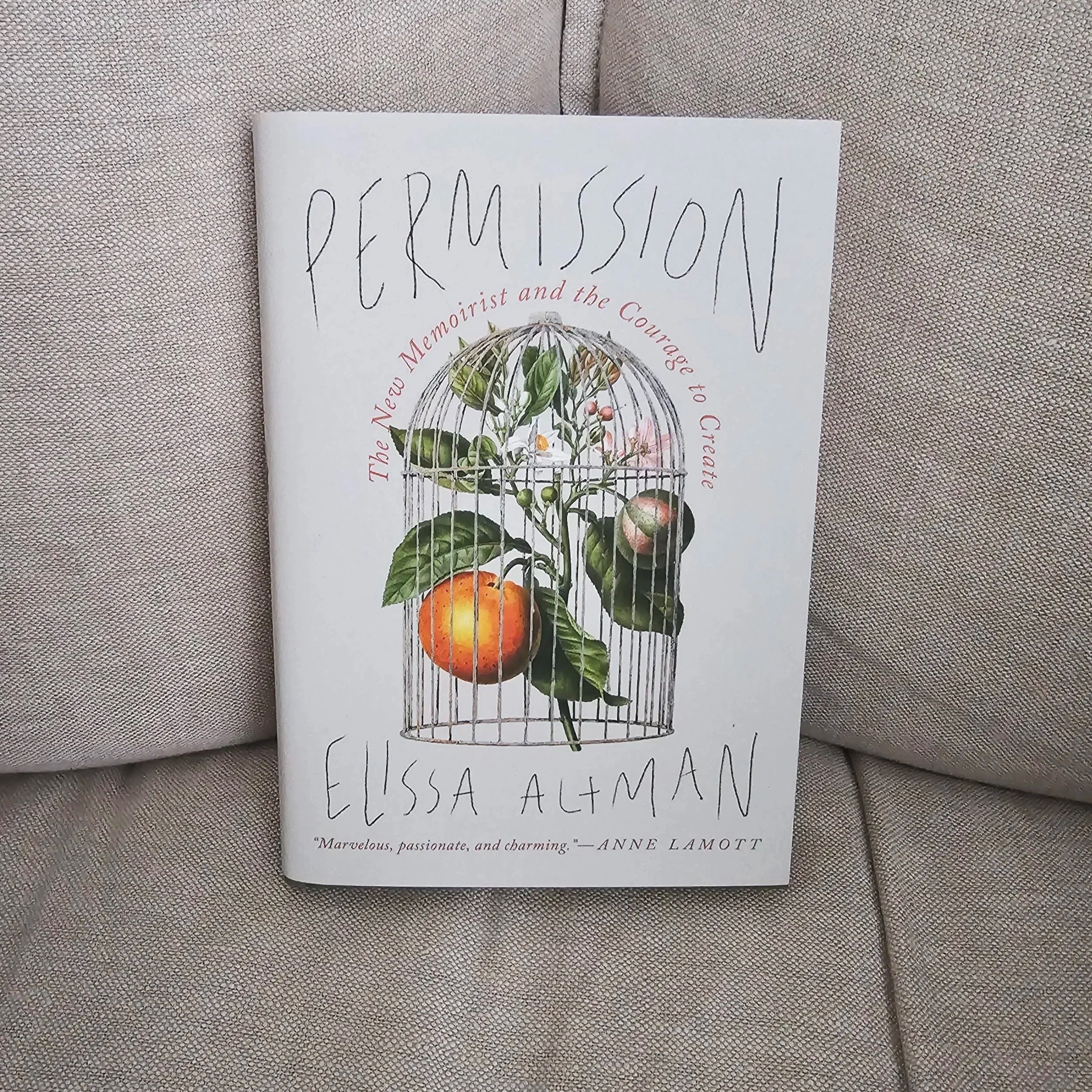
Two weeks before Christmas, I snuggled on the couch in front of our twinkling tree and finally read Permission: The New Memoirist and the Courage to Create by Elissa Altman. Finally, because although I purchased the book when it came out last March, I spent most of 2025 checking out too many library books and finishing my memoir manuscript. And yet, we also find books when we need them, and when this one was pulled from the shelf, it felt like the right time.
Inside the pages are stories about the thorny elements of memoir—risk, motivation, tension—that arise in the course of writing. In Elissa’s case, her insights have come at great cost. In a previous memoir, she recounted a story that was, as she describes it, “a non-secret secret,” which is to say that although it fundamentally altered her father’s life and is essential for understanding her lineage, it was also a story that came up regularly around the dinner table. Common knowledge. Extended relatives, however, did not agree with her having permission to tell this particular story, and after the book’s publication, Elissa became “sliced out of my family.”
Who am I to tell my story?
It’s a question that has crossed the mind of every memoirist, and in many cases, has stopped people from writing their stories in the first place.
So, how do we give ourselves permission to write the stories that we’re compelled to tell, when we’ve been told that we shouldn’t?
A little over halfway through the book, in a chapter about perfectionism, I sat up a bit straighter.
“I realized how limiting perfectionism can be, that its roots are born in the hierarchy—the good, better, best—of comparison.”
This. This was what kept me from my own draft for years.
In my own memoir, I share about my miscarriage and its aftermath. It’s about a lot more than that, but the experience was central to everything that came after, as well as understanding some circumstances that came before. And it almost became a secret, even to myself.
Who am I to tell my story?
Almost immediately after the loss, I began engaging in grief comparison, to the point where I began wondering if what happened to me was actually real.
Who am I to tell my story when I know someone who had a miscarriage at 18 weeks? Who am I to tell my story when babies are stillborn?
It’s very difficult to write a memoir if you haven’t given your own story permission to exist.
To no longer dismiss your experience, but to wrap your arms around it. To grieve it in any way you need, and for however long you need, a permission I didn’t grant myself for a very long time.
No one told me it was too shameful to speak of. I got there first. I told me not to speak of it. The experience shattered everything I thought I knew about how my body was supposed to work, and because I was not perfect at pregnancy, I tried to be perfect at solving the problem at hand.
Who needs grief when you can manage color-code a supplement spreadsheet instead?
As I I turned over this chapter in my mind, I began thinking about the ways perfectionism (and comparison) impact our experience of memoir writing.
First, there may be a cloud of shame sitting a few feet above our heads at all times, preventing us from ever picking up a pen, or questioning our right to. This shame could come from the outside (as in Elissa’s case) or from the inside (in my case). And when you reach the point of believing you have a right to tell your own story as you experienced it, perfectionism may stifle your writing process.
“The world we live in demands that our experiences be extraordinary, exceptional, large. My story is bigger than yours. My story is shinier than yours. My story is more outrageous than yours.”
Yes. You compare your story to other, more unbelievable stories. Stories so large they could be turned into a feature-length film. You didn’t hike the Pacific Crest Trail, alone, to grieve the death of your mother, so you begin to shrink your own experience down to a grain of sand, small enough disappear with a single breath.
You begin to doubt.
To this, Elissa offers: “Peel back the layers of humanity, and begin your early draft from the most mundane of places.”
Dig into the senses.
Get granular.
Give us details.
If we can do this—merely move forward one sentence at a time—eventually we may arrive at a place of “meditative creation.”
This is a place of deep freedom and flow, where “the words seem to come effortlessly, hobbled by neither shame or fear, nor the voice of an elder saying to give it up because it’s not impeccable—we are no longer bound to the stultifying problems inherent in perfectionism. Creative paralysis disappears. Instead, we’ve become a vessel through which the work travels in a way that can only be described as mystical.”
My whole body relaxed when I read that, and it settles me even now.
So here’s to the deep work, the necessary transformation, the memory that floats up while you’re driving to the grocery store.
Here’s to granting ourselves permission to access the truth of our experience. The mystical depths that pull us to the page despite our reservations.
Here’s to all the meaningful and mundane moments that make up a life, and in the hand of a writer—you and me—can be stitched and shaped into a story that someone else might need to read.